Vardhaman Capital Pvt Ltd.
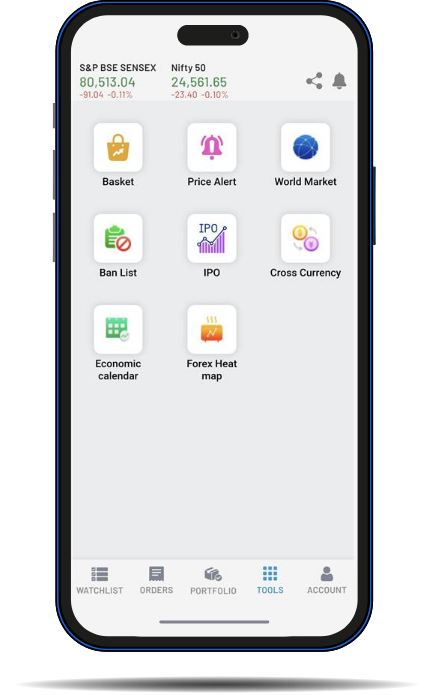
Vardhaman Capital App
Download the Vardhaman Application From Play store & Apple Store
Scan the QR Code to Instantly Install the App on Your Smartphone.



back top
 Authorised Persons Details
Investor Grievance Escalation Matrix
Authorised Persons Details
Investor Grievance Escalation Matrix

Send Us A Message Anytime
Send Us Message

Answers To More Questions.
Explore FAQ's

Share Your Phone Number, We Will Call You Back.

Kolkata, West Bengal Bareilly, Uttar Pradesh Haldwani, Uttarakhand

25 Swallow Lane, Wardley House, 2nd Floor, Kolkata - 700001


Monday to Saturday – 9:30 am to 6 pm

No — derivative trading (F&O trading) is not considered speculative income under Indian Income Tax Law.
Every broker must have a Grievance Redressal Mechanism.You can file a complaint through:Email to broker support-Raising a ticket on their platform-Calling customer care
You can use UPI, Net Banking, NEFT, IMPS and RTGS to add funds.
Added funds are reflected in your ledger in real-time.
By clicking, you will be shown the maximum withdrawal amount. By entering the same or less than the maximum amount, you can withdraw that particular amount, and it will be credited to your bank.
After Market Order (AMO) is a type of market order that is place by an investor after the regular market session is closed. AMO orders are places on the exchange at the opening of the next market session. The timing to place an AMO is between 5:00 PM to 9:00 AM for NSE.
Demat Account: Holds securities in electronic form. Trading Account: Opened with a SEBI-registered broker for executing trades. Bank Account: Used for fund transfers related to trading activities.
There is one fundamental difference between trading accounts and DEMAT accounts – a trading account allows you to buy and/or sell orders for shares, whereas a DEMAT account only allows you to hold shares and securities. When you place a buy/sell order through your trading account, the securities are debited from or credited to the DEMAT account. As such, both accounts are synced to one another.
The basic eligibility to open a trading account is as under: You need to be either a Resident Indian, a Non-Resident Indian (NRI), a Person of Indian Origin (PIO) or an Overseas Citizen of India (OCI). You should be above 18 years old. You should have a functional bank and DEMAT account to link to the trading account. You should also have a valid ID and address proof documents and complete the required Know Your Customer (KYC) process
Internet based trading - The eligible brokers give investors access to the market via their app/website. After logging in, investors can view live price quotes from the market and can place orders themselves. Trading through Mobile - Similar to internet based trading, eligible brokers also provide application/tools which the investors can download on their mobiles to trade on stock exchanges. Call and trade - An investor can call his broker, identify himself with the UCC code and place an order. The dealer at the other end will place the order and confirm the status of the same on the call. Visit to broker’s office – An investor can also choose to visit the office of the stock broker to place orders.
Securities Transaction Tax (STT): 0.1% on delivery, 0.02% on futures sells, and 0.1% on options sells. Other levies include transaction charges, GST, SEBI charges, and stamp duty.
MTM is an abbreviation for "Marked To Market". It is a method used to evaluate or measure the fair market value of fluctuating assets and liabilities. In the trading and investment world, securities like mutual funds and futures are marked to market to show their current or present market value. MTM Squaring off is essentially a trading style that investors use in day trading. They buy or sell specific quantities of assets (typically shares) and reverse their transactions later in hopes of earning a profit.
Margin funding, also known as Margin Trading facility, is a service provided by brokerage firms through which traders can get the necessary funds to buy more units of stocks, currencies, commodities, etc., from their brokers. Essentially, the margin funding facility allows you to buy more units of securities than you can afford by borrowing funds at a nominal interest rate from your broker. You can get the funds by using your shares as collateral, and you must repay or square off the amounts funded by a specific period.
SEBI demands 25% maintenance margin and brokers must report margin use four times a day. Failure to comply can result in liquidation within 5 days.
Only up to 65% value of shares (post haircut) can be pledged, held in a separate account, and debited to meet margin obligations. Brokers may liquidate pledged collateral if you don’t top-up.
Yes, visit https://ipo.meon.co.in/vardhaman to apply for IPOs and view upcoming and closed IPOs.
Yes, download AIM WEALTH from Google Play Store and Apple App Store to invest in mutual funds.
Cash settlement to the trading account usually happens on T+2 day if the exchange is unable to obtain the shares in the auction. The probability of cash settlement is lower for liquid stocks and higher for illiquid stocks.Did you know? The price at which the transaction is settled to the trading account, known as the close-out price, is generally over 20% higher than the stock's settlement price on auction day. This amount can be used to purchase the stocks again once the cash has been credited to the trading account.
Pay-in is the process of transfer of funds or delivery of securities to the Clearing Corporation to settle a buy or sell trade obligation respectively. Pay-out is the process of transfer of funds or delivery of securities from the Clearing Corporation to settle a sell or buy trade respectively. Pay-in and pay-out are part of settlement mechanism. The scheduled dates for the same are notified by the stock exchanges from time to time.
DDPI has been introduced to mitigate the misuse of Power of Attorney (PoA) by allowing the use of DDPI for the following four purposes: rni. Transfer of securities held in the demat accounts of the client towards settlement obligations; rnii. Pledging / re-pledging of securities in favour of stock broker / clearing member for the purpose of meeting respective client’s margin requirements; rniii. Mutual Fund transactions being executed on stock exchange order entry platforms; rniv. Tendering shares in open offers through stock exchange platformsrnThe client may use the DDPI or opt to complete the settlement by issuing physical Delivery Instruction Slip (DIS) or electronic DIS (eDIS) themselves. Hence, with the Page 4 of 10 implementation of DDPI, PoA shall no longer be executed for the purposes specified above. DDPI is not a mandatory requirement as per SEBI / stock exchanges.
A Power of Attorney (PoA) is a document executed by the client in favour of the stock broker to authorize the broker to operate the client’s demat account and bank account for purposes as specified by SEBI from time to time. Power of Attorney is not a mandatory requirement as per SEBI / stock exchanges.
Any person, individual, partnership firm, LLP or body corporate, who is appointed as such by a stock broker and who provides access to trading platform of a stock exchange as an agent of the stock broker is an Authorised Person. Details of the broker with whom the authorised person is registered may be checked on websites of the respective stock exchanges.
Under pledge/re-pledge mechanism, margin obligations in form of securities are met by the client by way of pledge/re-pledge in the depository system and title transfer of securities to the client collateral demat account of the stock broker /clearing member for margin purposes is not permitted. By creating pledge/re-pledge mechanism, the securities of client remain in respective client's demat account and entire trail of the securities utilised for margin purposes is available. Pledge is created with the consent of client and securities do not move out from the demat account of the client. Further, clients have complete visibility of collateral placed with clearing corporation on the website of respective clearing corporations.
If the seller defaults in delivery of the shares, the clearing corporation would put the undelivered shares for auction. The clearing corporation purchases the requisite quantity in the auction market and gives them to the buying stock broker. The shortages are met through auction process and the difference in price indicated in contract note and price received through auction is paid to the clearing corporation by the selling stock broker, which may be recovered from the client.
The maximum brokerage that can be charged by a broker may differ across stock exchanges. As per the BSE & NSE Bye Laws, the brokerage that can be charged by a stock broker are as under: rnCapital Market Segment: The maximum brokerage chargeable by a stock broker shall be 2.5 % of the contract price exclusive of statutory levies. Where the sale / purchase value of a share is Rs.10/- or less, a maximum brokerage of 25 paise per share may be collected.rnFutures contracts:The maximum brokerage chargeable by a stock broker in relation to trades executed on the stock exchange shall be 2.5% of the contract value exclusive of statutory levies. rnOption contracts: The stock broker shall charge brokerage for option contracts on the premium amount at which the option contract was bought or sold and not on the strike price of the option contract. The brokerage on options contracts shall not exceed 2.5% of the premium amount or Rs.100/- (per lot) whichever is higher. rnIn the derivatives segment, brokerage can only be charged in respect of trades executed on the stock exchange, hence brokerage cannot be levied on expiry / exercise / assignment of contracts
Every stock exchange is required to establish an Investor Protection Fund (IPF) with the objective of compensating investors in the event of defaulters' assets not being sufficient to meet the admitted claims of investors, promoting investor education, awareness, and research. The IPF is administered by way of registered trust created for the purpose. The IPF Trust endeavors to make good claims for compensation which may be submitted by a stock broker’s investor who suffers any loss arising from the said stock broker declared as a defaulter by the stock exchange.
Arbitration is an alternative dispute resolution mechanism provided by stock exchanges for resolving disputes between the stock brokers and their clients in respect of trades done on the exchange.
Holdings reflect the securities you own in your Demat account (visible from T+1 onwards), while Positions indicate your current intraday or derivatives trades (updated in real-time)
Derivative contracts where Futures obligate both parties to buy/sell at a set price/date, while Options give the right (not obligation) to do so.
F&O carry high risk including loss of entire margin, leverage-related amplified losses, potential physical delivery obligations, ban periods during extreme volatility, open interest limits, and lot-size restrictions.
It refers to closing your near-month F&O position and opening an equivalent one in the next-month series, to carry over the position.
Electronic storage offers convenience, faster settlements (T+2), reduced risk of theft/damage, auto credit of corporate actions (bonus, splits), and consolidated portfolio view.
VCPL allows trading on both the NSE and BSE for securities that are in compulsory demat form in the Cash segment.
You can place Limit Orders, where you set max (buy) or min (sell) prices, and Market Orders, which execute at the best available price. Any unfilled portion can be automatically converted to a limit order at the last traded price.
Yes—before execution you can modify or cancel an order (fully or partially executed), directly via the Order Book
SEBI’s peak margin rules require a buffer on sell proceeds—a portion is retained until end of day. 100% is usable for trading, but withdrawal is allowed from T+1.
Retail investors can bid up to ?200,000 using UPI. Above that, or for other categories, ASBA net-banking method is used
No. Only UPI apps/banks approved by NPCI (approx. 50) are allowed. Third-party UPI IDs or bank accounts are not permitted.
Regular IPO days: 10:00?AM – 5:00?PM, Monday to FridayrnrnrnIssue close day: Bids accepted until 3:00?PM (exchanges may extend, but banks close earlier)
VCPL does not charge application fees—you just pay the IPO investment amount. Funds are blocked temporarily and released if no allotment is made
Through VCPL Markets app and website - <a href=" https://vardhamancapital.co.in/ipo.php" target="_blank">https://vardhamancapital.co.in/ipo.php</a>
I'm a cool paragraph that lives inside of an even cooler modal. Wins!


About The Software And Guidelines To Use It :-
You Can Access A Variety Of 'Post-Trade' Related Data Through The Software. Your Debit, Credit Balances, DP Holdings, Statement Of Profit And Loss, Trade Register Etc. Are All Available Year On Year And Are Updated On A Day-To-Day Basis. This Facility Is Provided By Vardhaman Capital Pvt. Ltd., A Leading Stock Broker Based Out Of Kolkata.
To Access, Call 033-68202044

About The Software And Guidelines To Use It :-
The Software Wealth Eoffice Is A Comprehensive Tool Where You Can Keep A Check Of All Your Investments Across Various Asset Classes. It Is A One-Stop Solution To Keep A Check Of Your Entire Portfolio And Your Net Worth. The Reports Of The Mutual Fund Investments That You Have With Us Will Be Available Automatically And Will Be Updated On A Daily Basis. All Other Investment Data Has To Be Manually Entered By The Client Once They Are Given Their Individual Login. Also, You Can Directly Do Online Transactions In Mutual Funds From The Software Itself.
This Facility Is Provided By Vardhaman Capital Pvt. Ltd. We Are A Leading Stock Broker Based Out Of Kolkata.
For More Information And To Get Access To Your Details,
Please Contact 9895447751
Form submitted successfully!