Book Appointment
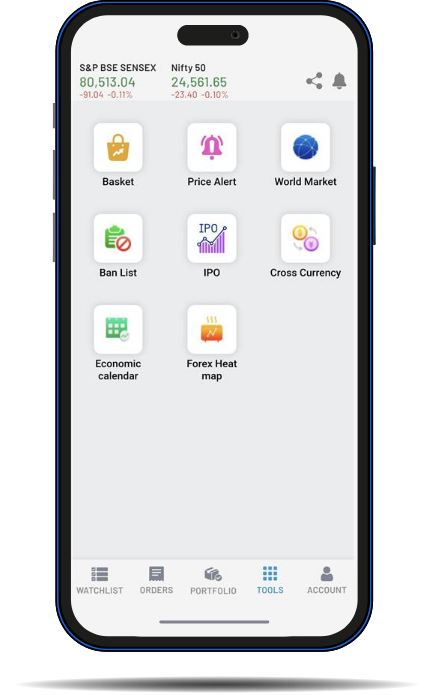
Vardhaman Capital App
Invest. Trade. Succeed
#MadeForTrade
Download the Vardhaman Application From Play store & Apple Store
Scan the QR Code to Instantly Install the App on Your Smartphone.



back top

Send Us A Message Anytime
Send Us Message
Answers To More Questions.
Explore FAQ's
Share Your Phone Number, We Will Call You Back.

Kolkata, West Bengal Bareilly, Uttar Pradesh Haldwani, Uttarakhand

25 Swallow Lane, Wardley House, 2nd Floor, Kolkata - 700001


Monday to Saturday – 9:30 am to 6 pm

You can open a Demat account online by visiting our website and completing the digital KYC process. Submit your PAN, Aadhaar, bank details, and complete IPV verification. Our team will assist you throughout the onboarding process.
You need three accounts:
Demat Account – To hold shares in electronic form.
Trading Account – To buy and sell securities.
Bank Account – To transfer funds for trading activities.
A Trading account is used to place buy/sell orders, whereas a Demat account is used to store shares electronically. When you trade, securities are credited/debited from your Demat account.
You must be:
Resident Indian, NRI, PIO, or OCI
Above 18 years of age
Have a valid PAN, bank account, and complete KYC process
Safe electronic storage
Faster settlement (T+2)
Reduced risk of theft/damage
Auto credit of bonus/splits
Easy portfolio tracking
Holdings: Shares owned and available in your Demat account (T+1 onwards).
Positions: Ongoing intraday or derivative trades updated in real-time.
Demat Debit and Pledge Instruction (DDPI) allows brokers to debit securities for settlement and margin purposes without Power of Attorney. It is optional as per SEBI rules.
PoA authorizes the broker to operate your Demat account for settlement purposes. It is not mandatory as per SEBI guidelines.
An AP is appointed by a stock broker to provide access to trading platforms as an agent of the broker.
You can trade on NSE and BSE in the Cash segment.
Charges include:
Securities Transaction Tax (STT)
Exchange transaction charges
GST
SEBI charges
Stamp duty
As per NSE & BSE bye-laws:
Equity: Maximum 2.5% of contract value
Options: 2.5% of premium or ₹100 per lot (whichever is higher)
IPF compensates investors if a broker is declared defaulter and assets are insufficient to meet investor claims.
Arbitration is a dispute resolution mechanism provided by stock exchanges to resolve disputes between brokers and clients.
Clients can pledge securities for margin purposes without transferring ownership. Shares remain in the client’s Demat account with full transparency
If a seller fails to deliver shares, the exchange conducts an auction to complete settlement. The price difference may be recovered from the seller.
SEBI mandates strict margin monitoring, pledge transparency, and regulated settlement cycles to ensure investor protection.
You can add funds via UPI, Net Banking, NEFT, IMPS, and RTGS
Funds are reflected in real-time, depending on the payment mode used.
You can request withdrawal from your dashboard. The eligible amount will be credited to your registered bank account.
Due to SEBI peak margin rules, part of the sale proceeds are blocked until settlement (T+1). However, 100% can be used for trading.
Pay-in: Transfer of funds/securities to clearing corporation.
Pay-out: Receipt of funds/securities after settlement.
Market Orders
Limit Orders
After Market Orders (AMO)
AMO is placed after market hours (5:00 PM – 9:00 AM) and executed when the market opens the next trading day
Yes, you can modify or cancel orders before execution from the Order Book.
Orders can be placed via:
Web platform
Mobile app
Call & Trade
Visiting broker office
MTM (Mark to Market) reflects daily profit/loss. MTM square off refers to closing intraday positions within the same trading day.
MTF allows you to buy shares by paying a partial margin and borrowing the remaining funds from the broker at applicable interest.
Minimum 25% maintenance margin is required. Non-compliance may lead to liquidation of positions.
Futures obligate buying/selling at a future date, while Options provide the right (not obligation) to buy/sell at a predetermined price.
F&O trading carries high risk including leverage impact, margin loss, volatility risk, and potential physical delivery obligations.
Rollover means closing the current month contract and opening the next month contract to continue your position.
I'm a cool paragraph that lives inside of an even cooler modal. Wins!


About The Software And Guidelines To Use It :-
You Can Access A Variety Of 'Post-Trade' Related Data Through The Software. Your Debit, Credit Balances, DP Holdings, Statement Of Profit And Loss, Trade Register Etc. Are All Available Year On Year And Are Updated On A Day-To-Day Basis. This Facility Is Provided By Vardhaman Capital Pvt. Ltd., A Leading Stock Broker Based Out Of Kolkata.
To Access, Call 033-68202044

About The Software And Guidelines To Use It :-
The Software Wealth Eoffice Is A Comprehensive Tool Where You Can Keep A Check Of All Your Investments Across Various Asset Classes. It Is A One-Stop Solution To Keep A Check Of Your Entire Portfolio And Your Net Worth. The Reports Of The Mutual Fund Investments That You Have With Us Will Be Available Automatically And Will Be Updated On A Daily Basis. All Other Investment Data Has To Be Manually Entered By The Client Once They Are Given Their Individual Login. Also, You Can Directly Do Online Transactions In Mutual Funds From The Software Itself.
This Facility Is Provided By Vardhaman Capital Pvt. Ltd. We Are A Leading Stock Broker Based Out Of Kolkata.
For More Information And To Get Access To Your Details,
Please Contact 03368202046
Form submitted successfully!

 Authorised Persons Details